✓ Technical background: Founder-led (Est. early 2010s) ✓ 11-50 lean team structure (Sub-scale stage) ✓ Hardware + Software offerings
Scaling with GTM: Renewable Energy Manufacturing – Application 1
A locally based renewable energy manufacturer published a commercial signal indicating a shift toward a GTM strategy to support their B2B C&I scaling needs.
Launched in Q1 2026 and amid rising energy-sector pressure, this points toward a structured, repeatable pipeline generation – an indication that is increasingly relevant for SMBs competing in C&I markets.
Where traction and internal capabilities are already established, adopting a marketing-led GTM strategy signals a deliberate shift toward a centralised source of truth within the commercial engine.
This decision reflects a clear understanding of alternative operating paths that remain viable within the existing structure – but have not been pursued as the primary model for scaling.
Viable Alternatives Overview
Market Positioning
Brand-led
The senior Brand specialist defines positioning, supported by agencies
GTM Orchestration
Sale/BD-led
Cross-functional orchestration aligned with market hypothesis from BD or Outbound.
Channel Enablement
Sale-led
Cross-functional enablement aligned with Sales’ directions.
MarOps Leadership
Brand-led
Brand strategy is the operational source of truth. External execution routes through the Branding Specialist.
Commercial Alignment
Revenue-first
Revenue-first centralised. Marketing remains reactive to Sales/BD priorities.
The GTM Specification: A Practical Application
Expanding from a residential baseline into B2B C&I is a structural pivot. From a commercial operator’s perspective, this isn’t just a volume play – it’s a translation exercise between technical capability and market relevance.
While sustaining the baseline is the primary delivery output, the focus here can be extended to the rigorous co-cataloguing between Marketing and Business Development. By standardising the strategic pursuit and tailoring sales enablement, the business will lay the foundation for the success of this version 1 strategy.
Once this foundation is stabilised, a more formal GTM scale-up version can be applied sustainably.
Renewable-energy-gtm-application-1 // Source: Public Local Industrial Signal (Published 26/03/2026)
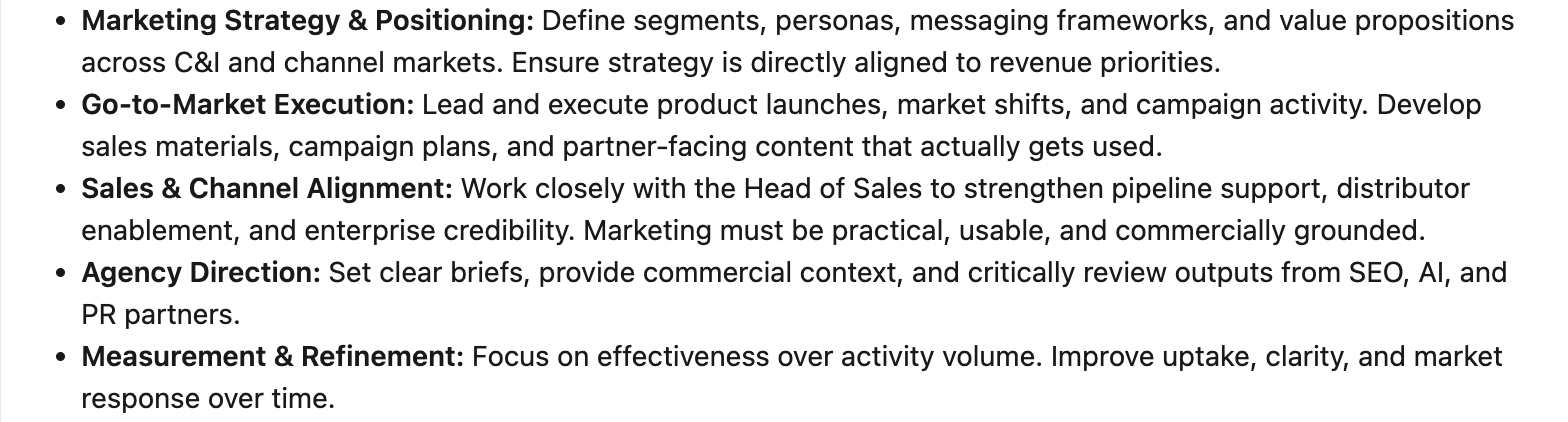
To determine whether this go-to-market strategy can be practically executed and integrated within existing constraints, the following compatibility was assessed against the 5 components of the “Renewable-energy-gtm-application-1” listed requirement.
Each component verifies each specification for executing this strategy and is engineered to integrate with available resources while maintaining commercial stability.
[01] Market Strategy & Positioning
Practical Spec 1: Identity Extension Extend the existing residential identity to support C&I relevance – incorporating technical authority, compliance alignment, and partner credibility.
Execution:Strategic Trust Baseline Leverage “Australian Made” equity alongside industrial capability to establish a high-trust baseline within B2B and regulatory-driven environments.
[02] Go To Market & Campaign Execution
Practical Spec 2:Cycle Synchronisation Structure marketing activity against a 12–18 month technical sales cycle, with defined touchpoints aligned to pipeline progression.
Execution: Cross-functional Cadence Synchronise with Sales and BD at a working cadence to ensure all campaign outputs are usable within live deal cycles.
[03] Sales & Channel Alignment
Practical Spec 3:Commercial Language Database Establish a shared commercial language across internal teams and external partners to reduce bid-response friction.
Execution:Frontline Enablement Standardised channel templates and messaging frameworks designed for rapid frontline adaptation and customisation.
[04] Agency Direction
Practical Spec 4:Partnership Accountability Introduce structured oversight across external partners to ensure creative output remains aligned with commercial priorities.
Execution:Performance Visibility Clear, periodic briefing combined with output evaluation and optimisation tied directly to sales efforts for the selected growth indicators.
[05] Measurement & Refinement
Practical Spec 5: Attribution Baseline Model Implement a baseline attribution model to connect integrated marketing activities with commercial outcomes.
Execution:Infrastructure Optimisation ROMI/ROI tracking built on existing ICT infrastructure, enabling iterative refinement without a tech stack upgrade.
The Operator’s Logic: Verified Engineering Capabilities
[01] Engineering GTM Capability: Senior Level
Based on a comprehensive inspection of the “Renewable-energy-gtm-application-1” specification requirements, the senior commercial marketing lead with engineering GTM capability should be able to deliver the execution aligned with the intended commercial logic and feasibility.
The business’s historical traction – built on a brand-first foundation and strategically leveraged outsourcing – provides significant equity for the first execution of the practical Spec 1 on Positioning.
The strategy’s structural design is sound.
The “heaviness” of the implementation now shifts from strategy to Execution, where the hands-on doing begins.
[02] The Software Early Enablement: Selective add-on
For a small business with a lean team at this sub-scale stage, growth also comes from bridging the gap between physical manufacturing and digital orchestration (IIoT + ERP) go-to-market, which can be an add-on.
[ RESOURCE: Beyond Silos: Marketing-led End-to-End GTM Orchestration ] This applied go-to-market application in SaaS provides the technical blueprints for synchronising Sales, Marketing, and Success teams. It outlines the specific data handover points required to stabilise a 12–18-month B2B Enterprise sales cycle.
Conclusion: Ready-to-apply Industrial GTM – Practical for Renewable Energy.
This “Renewable-energy-gtm-application-1“ that was applied to this local business also has strategic commercial value for other compatible renewable energy operators, especially with the local Australian manufacturing capability.
It accounts for a dual-stream (Hardware + Software) offering at small-to-medium organisations. And have the potential to extend to Servitisation or Portfolio paths, when applicable.
Strategy Status: Highly Advantageous. LastVerification: 01 April 2026.
Commercial signals in Australian industrial markets – recorded before they became obvious. Recruitment activity. Title drift. Capability acquisition, etc. The strategic observation layer about commercial intents, before outputs are visible and monitorable.
The written-down transitioning layer that enables cross-functional execution. Transition briefs, alignment documents, the connective tissue between strategy, and the remaining ambiguity while executing.
Sophisticated commercial plays worth watching — across SaaS, ERP, ICT, IIoT and industrial. These sit outside what GTM Depot builds toward, documented because the signal still matters.
Cookie Consent
We use cookies to improve your experience on our site. By using our site, you consent to cookies.
Contains information related to marketing campaigns of the user. These are shared with Google AdWords / Google Ads when the Google Ads and Google Analytics accounts are linked together.
90 days
__utma
ID used to identify users and sessions
2 years after last activity
__utmt
Used to monitor number of Google Analytics server requests
10 minutes
__utmb
Used to distinguish new sessions and visits. This cookie is set when the GA.js javascript library is loaded and there is no existing __utmb cookie. The cookie is updated every time data is sent to the Google Analytics server.
30 minutes after last activity
__utmc
Used only with old Urchin versions of Google Analytics and not with GA.js. Was used to distinguish between new sessions and visits at the end of a session.
End of session (browser)
__utmz
Contains information about the traffic source or campaign that directed user to the website. The cookie is set when the GA.js javascript is loaded and updated when data is sent to the Google Anaytics server
6 months after last activity
__utmv
Contains custom information set by the web developer via the _setCustomVar method in Google Analytics. This cookie is updated every time new data is sent to the Google Analytics server.
2 years after last activity
__utmx
Used to determine whether a user is included in an A / B or Multivariate test.
18 months
_ga
ID used to identify users
2 years
_gali
Used by Google Analytics to determine which links on a page are being clicked
30 seconds
_ga_
ID used to identify users
2 years
_gid
ID used to identify users for 24 hours after last activity
24 hours
_gat
Used to monitor number of Google Analytics server requests when using Google Tag Manager